UI&UX

Web Design

Responsive Design

Branding

UX Research

FairShare: Rethinking Shared Finance Through Social Design

My Role

Sole UX Designer

Team

-

Timeline

8-10 Weeks

Tools Used

Figma/Miro

Notion/Google Docs

Lookback

Relume.io/v0

Overview

FairShare is a social-fintech app that makes sharing money with friends simple, fair, and fun. It reimagines group expense management by blending Splitwise-style functionality with social and gamified interactions. Users can automatically split bills, save collectively for shared goals, send friendly reminders, and celebrate milestones — all while maintaining transparency and harmony in their relationships.
The Problem

Splitting money among friends sounds simple.
In reality, it’s anything but.

People regularly share expenses for:

  • Trips

  • Rent and utilities

  • Group dinners

  • Gifts and celebrations

Yet money introduces tension:

  • Asking someone to pay feels awkward

  • Reminders feel confrontational

  • Transparency can feel like oversharing

  • Existing apps feel cold, transactional, or invasive

Most tools solve the math.
Very few solve the social friction.

Why This Problem Matters

Research and industry patterns show that:

  • Money is one of the most emotionally charged topics in friendships

  • Users often avoid follow-ups to “keep the peace”

  • Public financial feeds increase discomfort rather than trust

  • People rely on multiple apps to manage one shared experience

Despite the popularity of finance apps, no tool meaningfully supports the emotional side of shared money.

Design Goal

How might we help people manage shared expenses and group financial goals in a way that feels transparent, motivating, and socially safe—without damaging relationships?

Understanding the User & Early Assumptions (Why They Were Wrong)

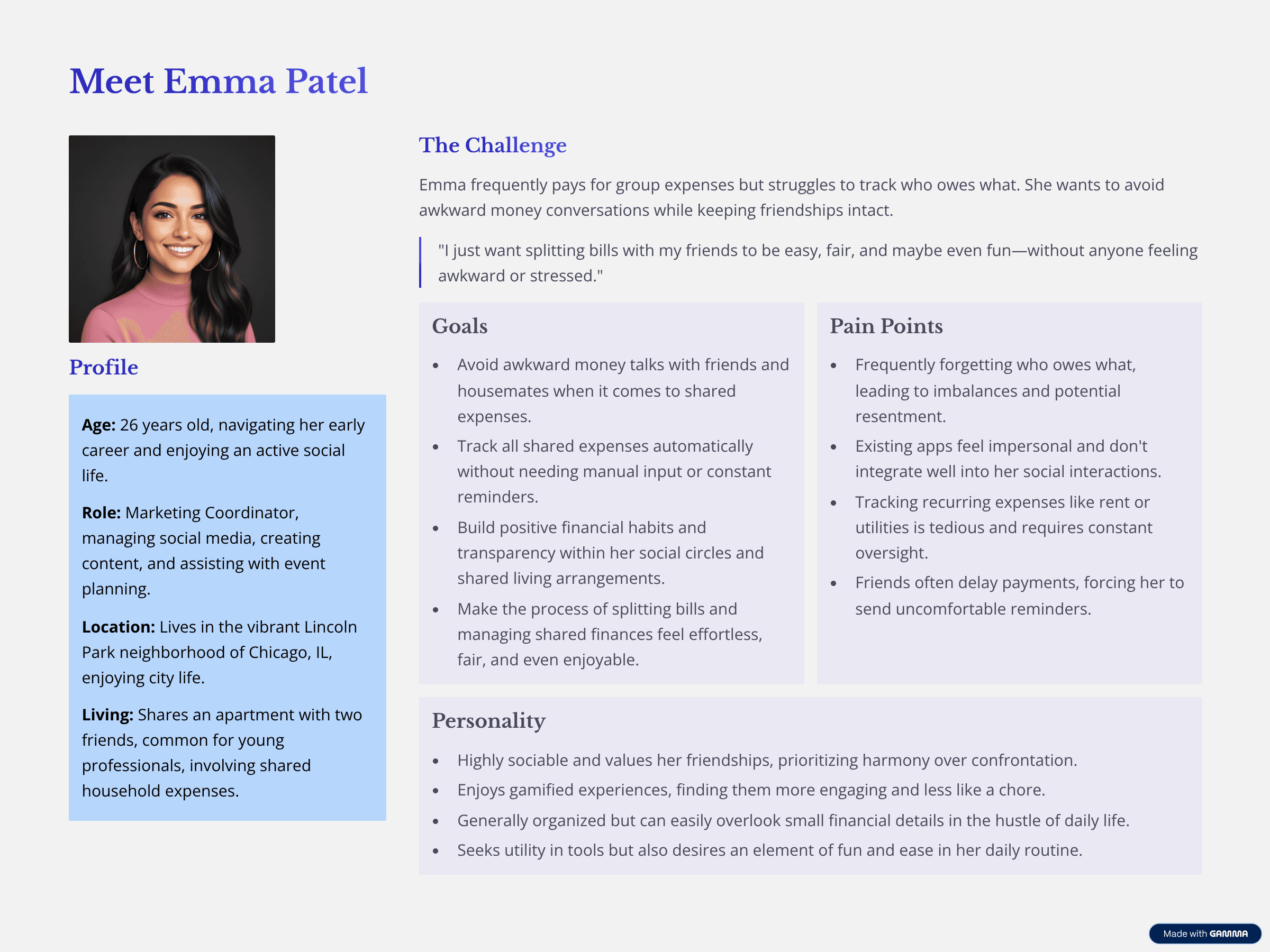
Primary Persona: Emma
Initially, I assumed:

  • Automatic activity updates would be helpful

  • Transparency meant visibility by default

  • Social feeds would naturally increase engagement

User research quickly challenged these assumptions.

Research & Discovery

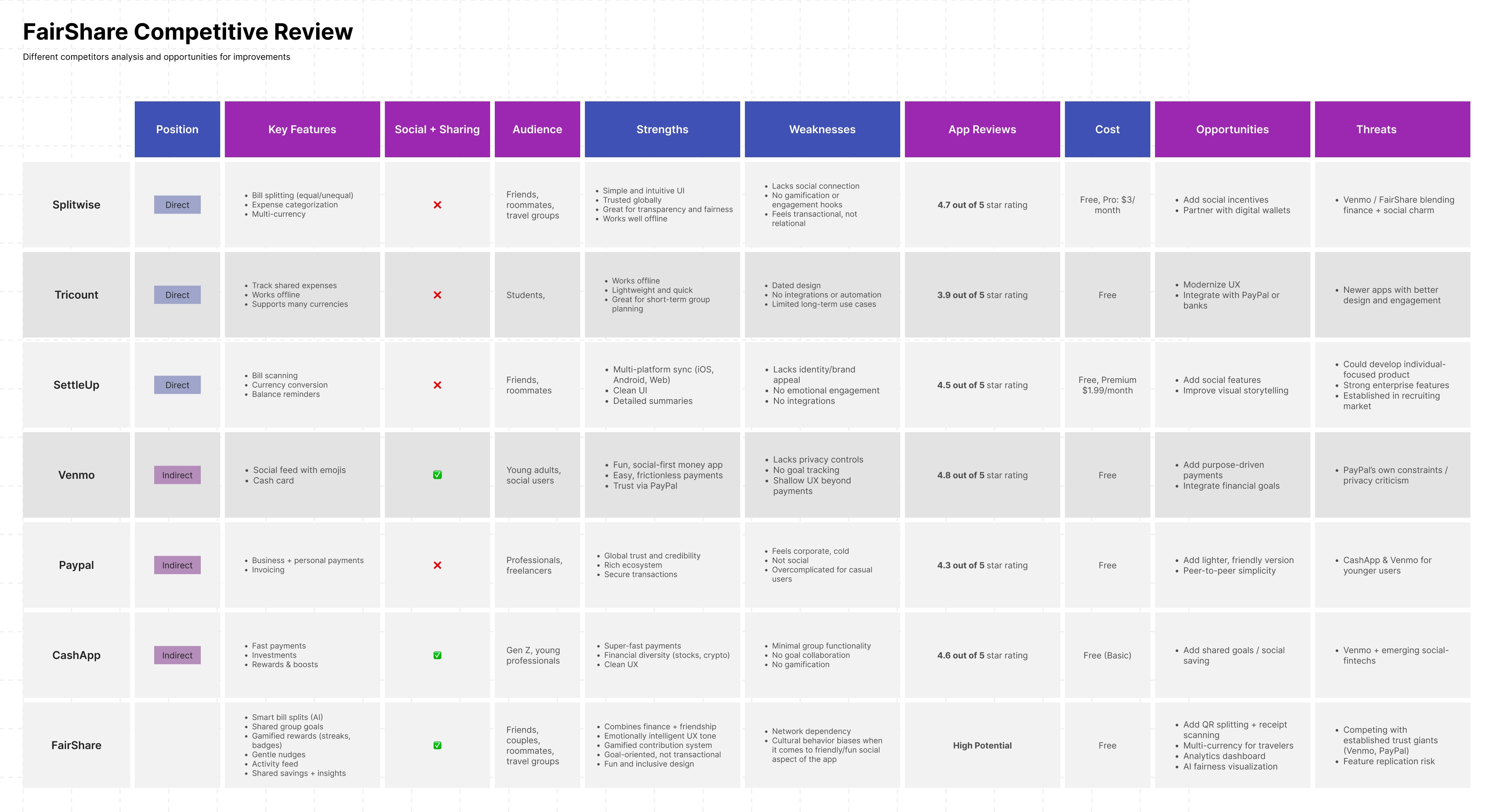
Method 1: Competitive Analysis

Apps Reviewed:

  • Splitwise

  • Tricount

  • SettleUp

  • Venmo

  • PayPal

  • CashApp

What I Studied:

  • Expense splitting flows

  • Privacy models

  • Social features

  • Motivation mechanics

Key Findings

  • Apps focus on either finance or social, rarely both

  • Public-by-default feeds cause discomfort

  • No app allows users to manually curate financial updates

  • Gamification and goal motivation are largely absent

Opportunity Identified:
Design a social-finance experience where users control visibility, and progress feels shared—not exposed.

Method 2: Design Review & User Testing

Participants: 4 users with UX familiarity and real experience using finance apps
Goals:

  • Evaluate the interpretation of social-finance features

  • Test navigation and core tasks

  • Understand comfort around sharing financial activity

Tasks Tested:

  • Create a shared goal

  • Add a contribution

  • Split a bill

  • Interpret the activity feed

  • Adjust privacy settings

Scenarios Used:

  • Saving for a “Trip to Japan”

  • Splitting a group dinner bill

What Users Told Me (Directly)

“I don’t want the app announcing what I did.”
“The feed feels generic—where’s the personalization?”
“I’m hesitant to share financial activity publicly.”
“I’m not sure what happens after I contribute.”

These comments reshaped the entire product direction.

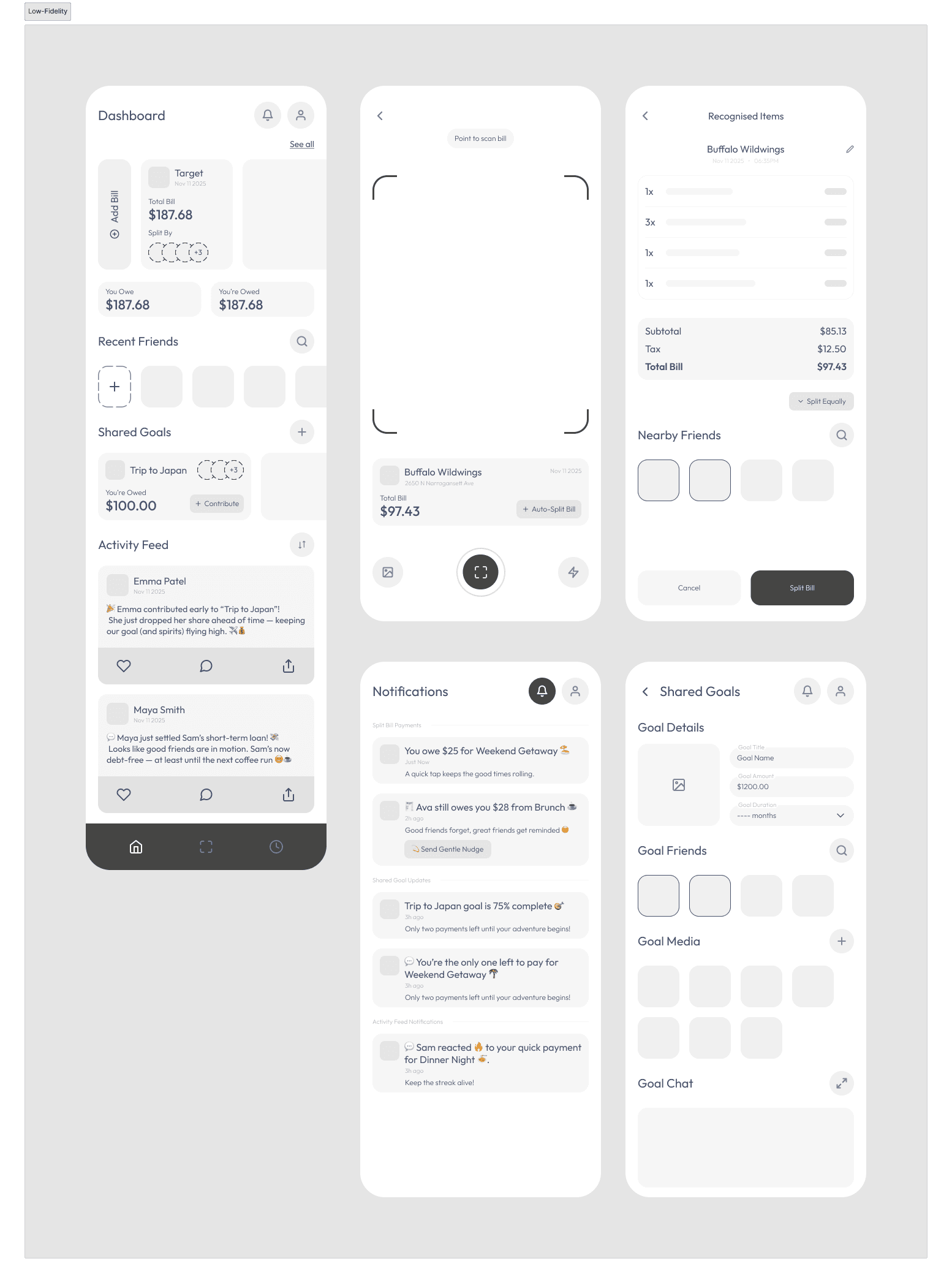
Low-Fidelity Exploration

I began with rough sketches focused on:

  • Dashboard-first navigation

  • Quick bill scanning

  • Shared goal visibility

  • Automatic activity feed

Early Structure:

  • Dashboard

  • History

  • Scan Bill

  • Chat

What Didn’t Work

  • Automatic feed posts felt invasive

  • Goal creation and chat felt blended

  • Contribution outcomes weren’t clear

  • Privacy controls were missing

Design Iteration: From Lo-Fi to Hi-Fi

User feedback led to major structural changes.

Key Improvements

1. Manual Activity Creation

Instead of auto-generated posts, users now:

  • Choose when to share

  • Write their own updates

  • Control visibility per post

This restored a sense of ownership and trust.

2. Privacy as a First-Class Feature

Every action includes:

  • Audience selection

  • Private / group-only / visible options

Privacy moved from a setting to a design principle.

3. Milestone Gamification

Users wanted motivation—not pressure.

Added:

  • Contribution badges

  • Group milestones

  • Progress celebrations

These reinforced teamwork without competition.

4. Clear Separation of Spaces

  • Goal creation

  • Goal overview

  • Group chat

Each now serves a distinct mental model, reducing confusion.

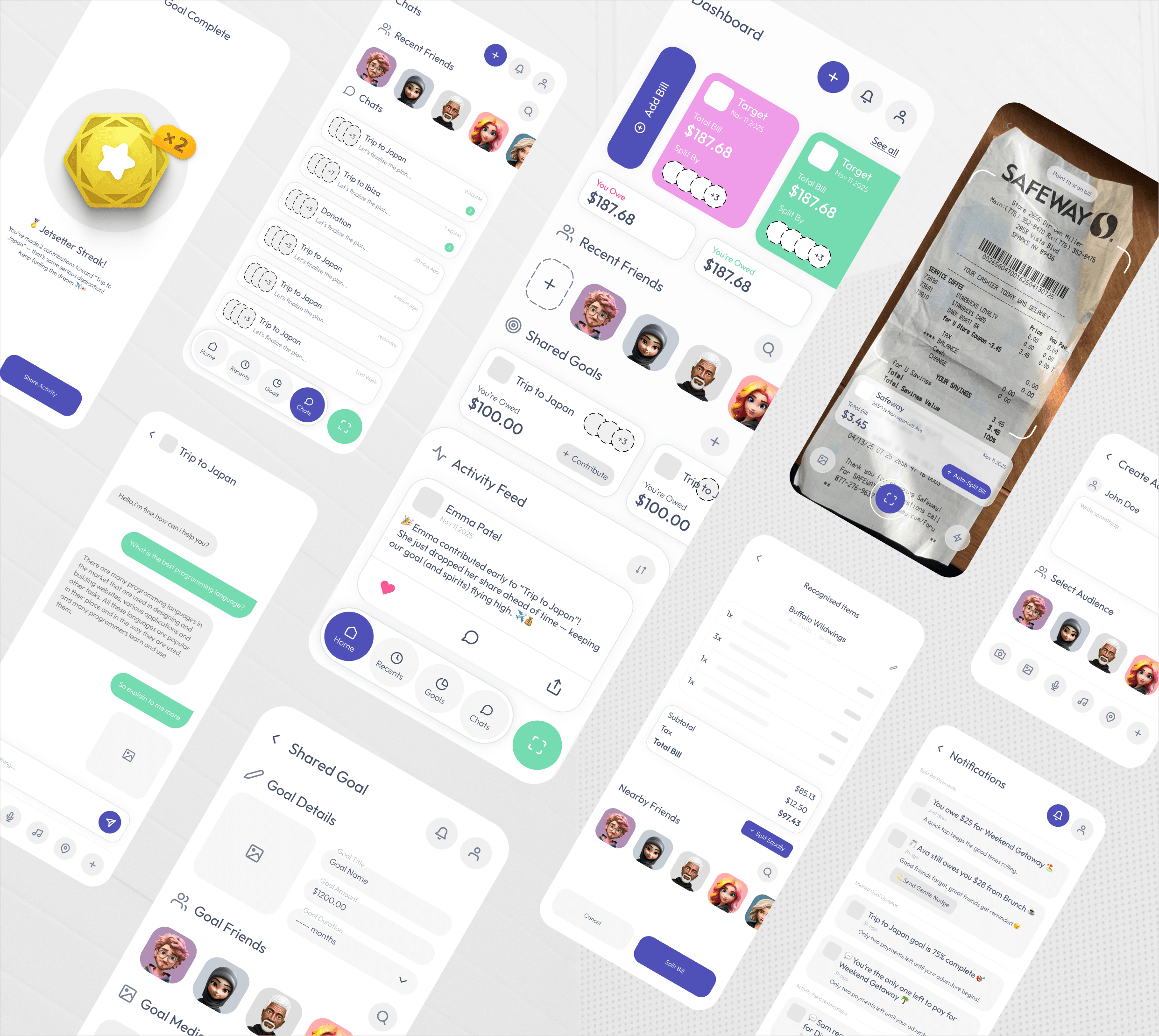
High Fidelity Screens
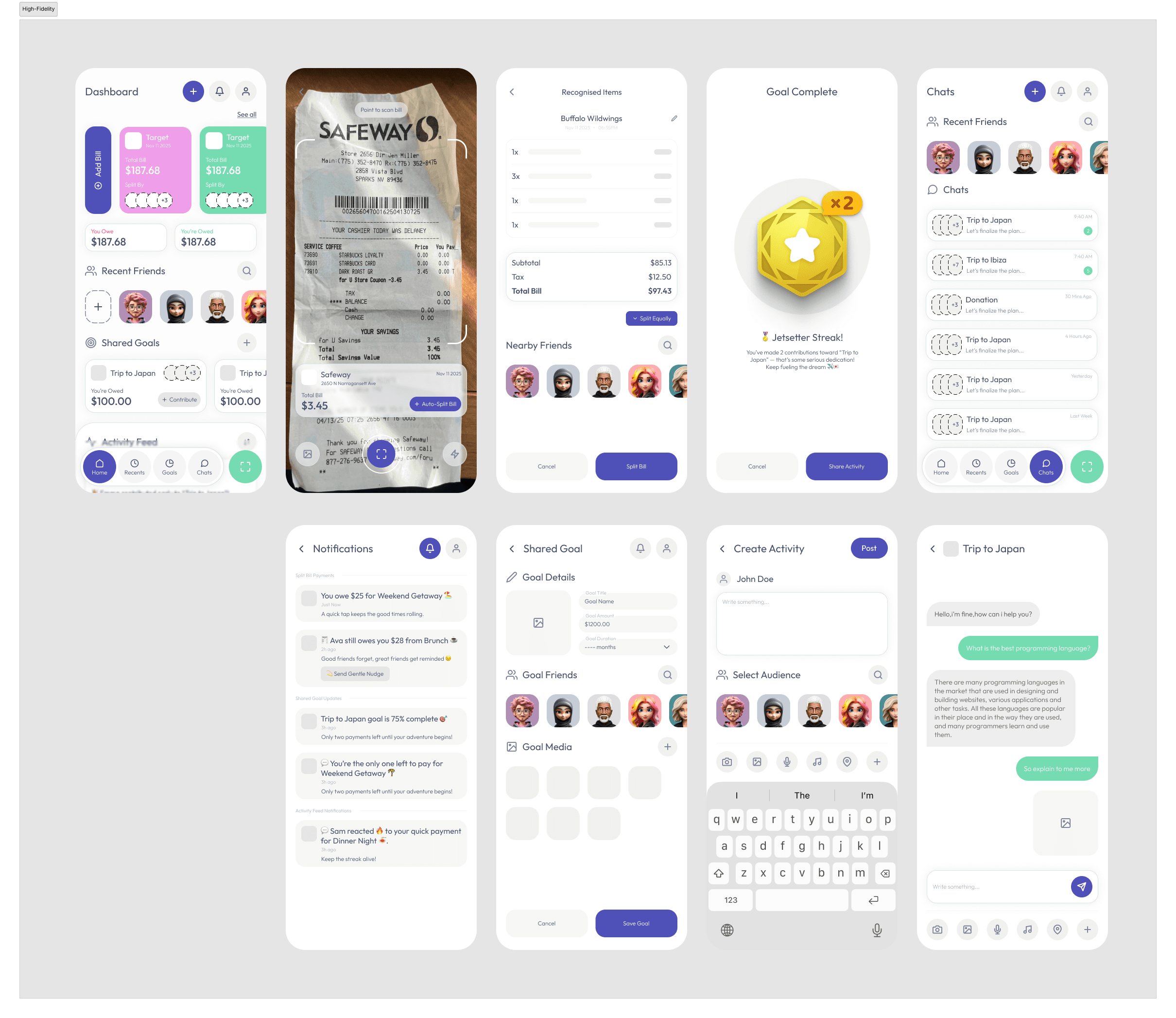
The Final Experience

Core Features

  • Smart bill splitting

  • Shared financial goals

  • Manual social updates

  • Privacy-first activity feed

  • Milestone-based motivation

The experience feels:

  • Supportive

  • Transparent

  • Social—but never invasive

Why This Works

FairShare doesn’t just track money.
It protects relationships.

By respecting emotional boundaries, offering control, and celebrating progress collaboratively, FairShare reframes finance as a shared experience—not a source of tension.
Reflection, Key Learnings & Future Opportunities

Designing FairShare reinforced that shared finance is not just a numerical problem, but a social and emotional one. Research and testing consistently showed that people care deeply about how financial actions affect their relationships. Features intended to increase transparency can quickly create discomfort if users feel they’ve lost control over what is being shared.

Key Learnings

  • Automatic activity updates were perceived as intrusive rather than helpful

  • Users strongly preferred manual activity creation with audience-level control

  • Blending goals, chat, and updates led to confusion and unclear mental models

  • Light, collaborative gamification increased motivation without social pressure

These insights directly influenced major design decisions, including making privacy controls visible at every step, separating goal creation from group chat, and introducing milestone badges that celebrate progress rather than competition.

Looking Ahead

There are several clear opportunities to extend FairShare further. AI-assisted features could support predictive bill splitting, smarter reminders, and goal insights that adapt to group behavior. More advanced privacy presets could reduce friction by learning user preferences over time. Finally, real-world pilot testing with roommate groups or travel groups would be essential to validate demand and refine the social dynamics at scale.

Final Takeaway

Designing financial tools for groups requires empathy, consent, and trust just as much as functional accuracy. FairShare aims to balance transparency with emotional comfort by design.

Other

Projects

FairShare: Rethinking Shared Finance Through Social Design

Figma/Miro

Notion/Google Docs

FairShare is a social-fintech app that makes sharing money with friends simple, fair, and fun. It reimagines group expense management by blending Splitwise-style functionality with social and gamified interactions. Users can automatically split bills, save collectively for shared goals, send friendly reminders, and celebrate milestones — all while maintaining transparency and harmony in their relationships.

The Problem

Splitting money among friends sounds simple.
In reality, it’s anything but.

People regularly share expenses for:

  • Trips

  • Rent and utilities

  • Group dinners

  • Gifts and celebrations

Yet money introduces tension:

  • Asking someone to pay feels awkward

  • Reminders feel confrontational

  • Transparency can feel like oversharing

  • Existing apps feel cold, transactional, or invasive

Most tools solve the math.
Very few solve the social friction.

Why This Problem Matters

Research and industry patterns show that:

  • Money is one of the most emotionally charged topics in friendships

  • Users often avoid follow-ups to “keep the peace”

  • Public financial feeds increase discomfort rather than trust

  • People rely on multiple apps to manage one shared experience

Despite the popularity of finance apps, no tool meaningfully supports the emotional side of shared money.

Design Goal

How might we help people manage shared expenses and group financial goals in a way that feels transparent, motivating, and socially safe—without damaging relationships?

JobSync: Simplifying the Job Search Maze

Figma

Miro/FigJam

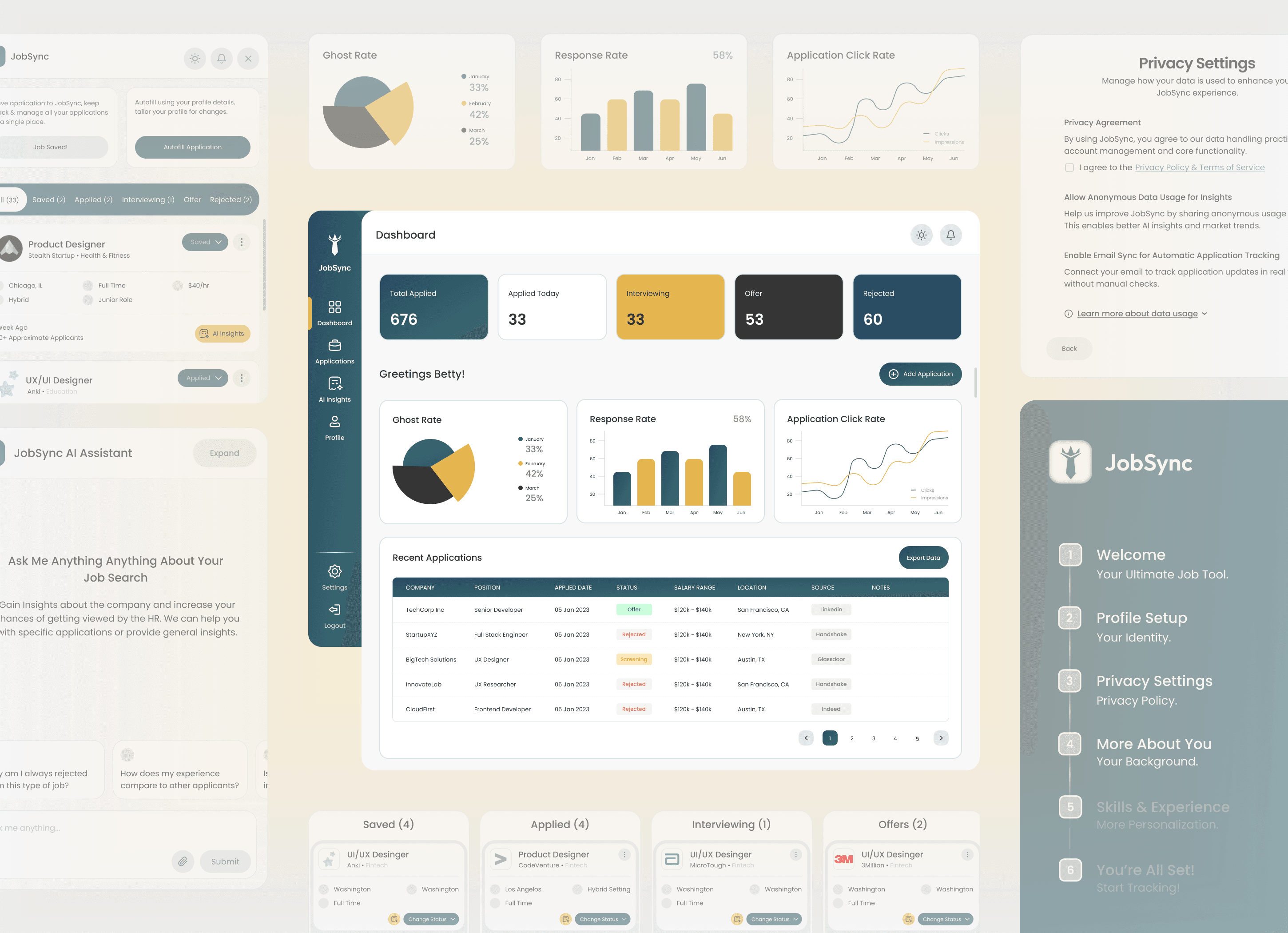
A browser extension that consolidates job applications, integrates email tracking, and delivers privacy-first, AI-powered insights—all to make job hunting feel less like chaos and more like progress.

Chirp: Enhancing Neighborhood Connectivity Through a Hyper-Localized Communication Platform

Figma/Figjam

Miro

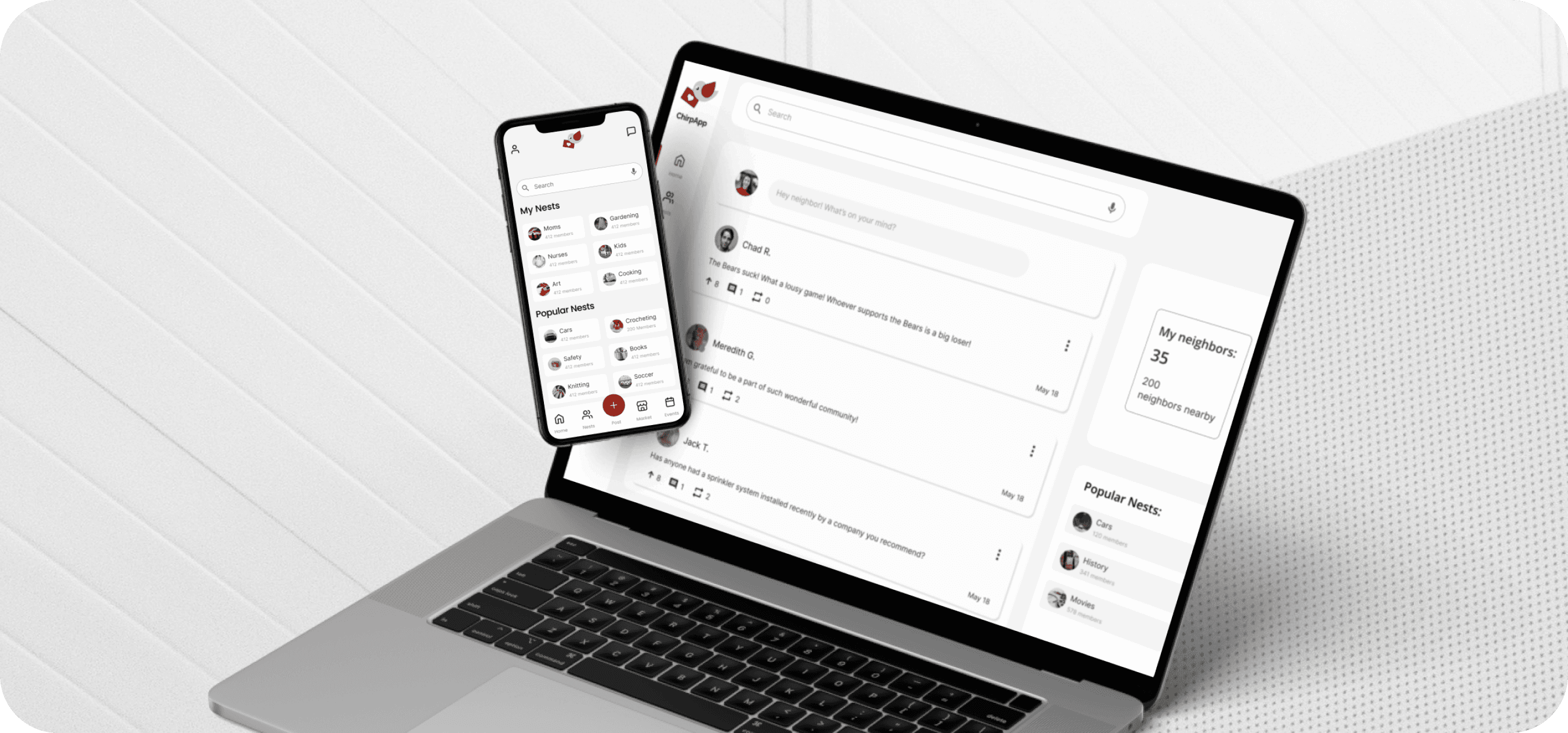
Chirp is a hyper-localized platform for neighborhood communication, available as both a mobile app and a website. Users can ask questions, create events, sell items, and message others. Chirp empowers users by allowing them to moderate content, ensuring the information is accurate and validated.

The Challenge

Feeling safe, connected, and informed is crucial to being a good neighbor and active community member. However, finding relevant local information and feeling safe interacting with strangers can be challenging. These issues deter users from building a sustainable and active community.

The Goal

Chirp aims to provide an engaging and enjoyable user experience by delivering hyper-localized neighborhood information. It allows users to moderate content and offers a user-friendly application that promotes active community interactions. 

Like what you see? Let's talk!

Shoot me an Email!

Or, if you decide to hit me up at a later date, Click to copy

Like what you see? Let's talk!

Shoot me an Email

Or, if you decide to hit me up at a later date, Click to copy

Like what you see? Let's talk!

Shoot me an Email

Or, if you decide to hit me up at a later date, Click to copy

© 2020 — 2025 | Shaik Aziz
Designed in Figma, Built in Framer

© 2020 — 2025 | Shaik Aziz
Designed in Figma, Built in Framer

© 2020 — 2025 | Shaik Aziz
Designed in Figma, Built in Framer